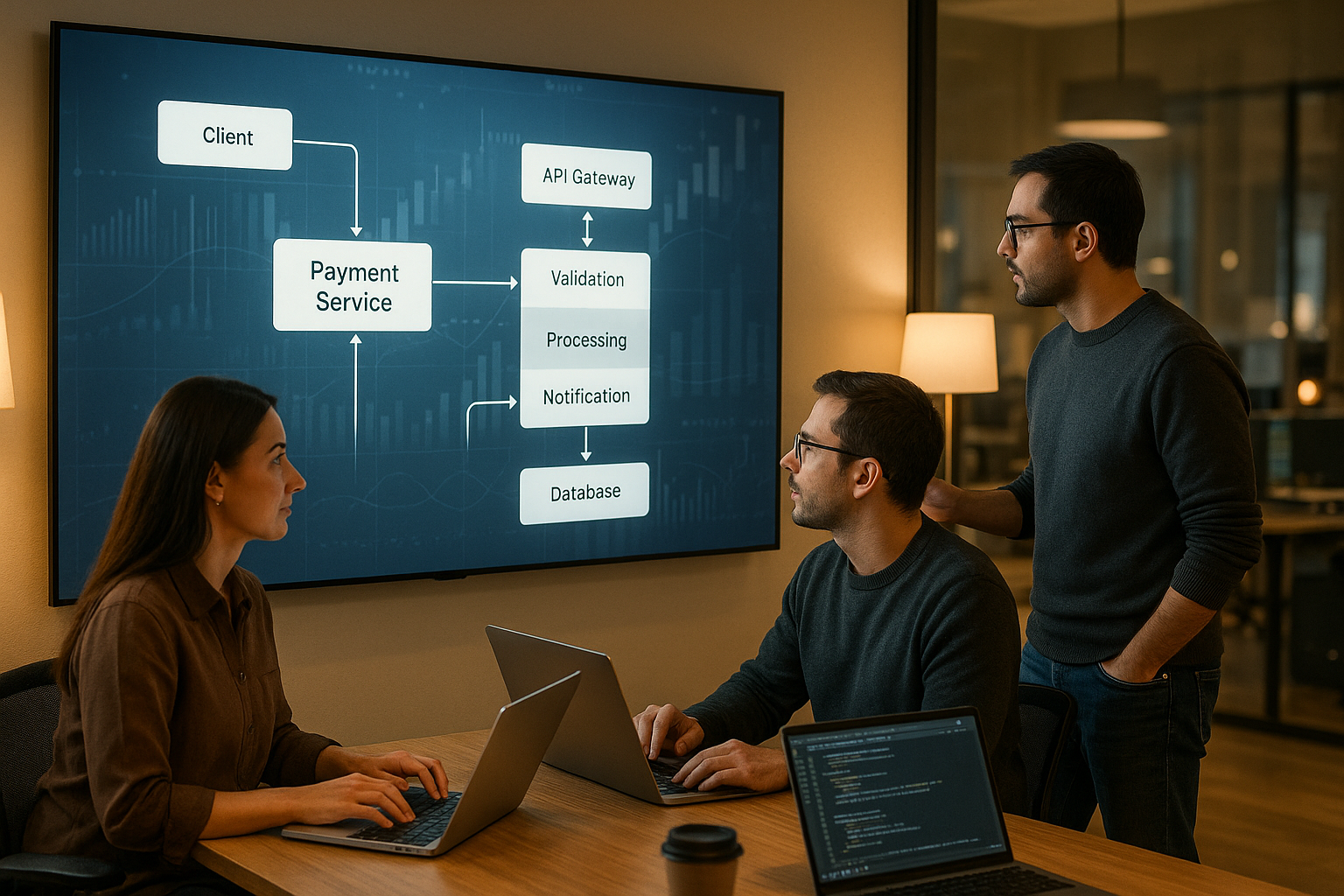
Building scalable payment microservices is key to handling high transaction volumes while ensuring reliability and security. Here’s what you need to know:
- Break down payment workflows into smaller, independent services like transaction processing, fraud detection, and settlement.
- Scalability is critical: Systems must handle peak loads during events like Black Friday, where transactions can reach millions per minute.
-
U.S.-specific requirements: Format currency as
$1,000.00, use MM/DD/YYYY dates, comply with PCI DSS, and support ACH transactions. - Core principles: Focus on modularity, fault isolation, event-driven communication, and strong security measures.
- Tech stack: Use cloud platforms (AWS, Azure, GCP), containerization (Docker), orchestration (Kubernetes), and API gateways for secure and efficient scaling.
Key Takeaways:
- Modular Design: Isolate services to prevent system-wide failures.
- Event-Driven Architecture: Use message brokers for real-time, asynchronous communication.
- Security First: Encrypt data, implement API gateways, and ensure PCI DSS compliance.
- Tools for Scaling: Leverage cloud services, Kubernetes, and monitoring tools like Prometheus.
By following these steps, you can create payment microservices that scale effectively, meet compliance standards, and provide a seamless payment experience, even under high traffic.
Core Principles of Payment Microservices Architecture
Creating payment microservices that can handle large transaction volumes starts with a solid foundation of architectural principles. These principles are the building blocks for the techniques outlined in the upcoming step-by-step design guide. Below are three key principles that drive scalable and reliable payment systems.
Modularity and Fault Isolation
Modularity means designing each microservice to handle a specific payment function independently. For instance, separate microservices might manage credit card authorization, fraud detection, transaction logging, and settlement processing.
This modular setup comes with tangible advantages. Deployments are faster – up to 60% quicker – and downtime is reduced by 50%. For example, if you need to update a fraud detection rule, you can do so without interfering with the credit card authorization process.
Fault isolation complements modularity by ensuring failures in one service don’t disrupt the entire system. Two design patterns help achieve this: the bulkhead pattern and the sidecar pattern. The bulkhead pattern works like watertight compartments in a ship – if one section floods, the others stay intact. Resources are partitioned so that a failure in one service doesn’t cascade through the system. The sidecar pattern, on the other hand, separates supporting functions like monitoring and logging into their own containers, keeping the core payment logic unaffected. For example, even if the monitoring system encounters an issue, payment processing continues uninterrupted.
This modular and isolated approach not only ensures reliability but also lays the groundwork for scaling through smooth service communication.
Event-Driven Design for Scalability
An event-driven architecture changes how payment microservices interact. Instead of relying on direct calls, services communicate by publishing and consuming events through message brokers like Apache Kafka or RabbitMQ. This setup allows for real-time processing and higher throughput.
Here’s how it works: when a customer completes a purchase, the payment service publishes a "PaymentProcessed" event. Other services, such as inventory, shipping, and analytics, consume this event to update stock, process orders, or log the transaction. This asynchronous communication is especially useful during peak traffic, as the system can queue and process events based on available resources.
However, this approach isn’t without challenges. Designing event schemas and managing issues like out-of-order or lost events adds complexity. Yet, for high-traffic payment systems, the ability to scale effectively outweighs these hurdles.
This event-driven model naturally ties into the need for robust security measures, which are critical for payment systems.
Security Requirements
Security is deeply embedded in the design of payment microservices, especially in the U.S., where strict standards like PCI DSS compliance are mandatory for over 90% of payment processors.
To protect data, use TLS for securing data in transit and AES for encrypting data at rest. Access should be controlled with RBAC, OAuth2, and API keys.
API gateways act as a security checkpoint, managing authentication, authorization, and rate limiting before requests reach individual microservices. This centralized control reduces the system’s exposure to potential attacks. For compliance, robust monitoring and auditing are essential – every access attempt, transaction, and system change should be logged with timestamps formatted in U.S. standards (MM/DD/YYYY with a 12-hour clock) to aid in detecting fraud or breaches.
The database-per-service pattern adds another layer of security by isolating each microservice’s data, limiting the impact of any potential breach.
These combined security measures create a multi-layered defense system. If one layer fails, others remain active to safeguard the payment system and customer data. For example, providers like Secured Payments (https://securedpaymentsllc.com) use these principles to deliver secure, reliable, and scalable payment solutions tailored for U.S. businesses.
Key Tools and Technologies for Scalability
The right tech stack is the backbone of a payment system that can handle heavy loads without breaking a sweat. By combining smart architectural principles with cutting-edge tools, payment systems can evolve into resilient and scalable solutions fit for today’s demands.
Cloud Platforms for Elastic Scaling
In the U.S., cloud giants like Amazon Web Services (AWS), Microsoft Azure, and Google Cloud Platform (GCP) dominate the landscape for scalable payment infrastructure. These platforms offer features like auto-scaling, managed databases, and serverless computing, which dynamically adjust resources based on transaction volumes. For example, AWS’s Elastic Beanstalk and Lambda handle over 10 trillion invocations monthly. This flexibility ensures that during high-demand periods – like Black Friday or holiday shopping – your payment system can seamlessly scale up and then scale down as traffic subsides.
For containerized environments, Azure Kubernetes Service (AKS) and Google Kubernetes Engine (GKE) provide robust orchestration tools. These services not only manage infrastructure but also comply with PCI DSS standards, making them a reliable choice for secure payment systems.
Containerization and Orchestration
Docker containers simplify deployments by packaging payment microservices with all their dependencies. This guarantees uniform performance across development, testing, and production environments, reducing the risk of unexpected failures.
The real magic happens with Kubernetes, which orchestrates these containers. According to a 2023 survey by the Cloud Native Computing Foundation, over 96% of organizations are already using or exploring Kubernetes for container orchestration. Kubernetes offers features like horizontal pod autoscaling and self-healing. If a payment processing container crashes, Kubernetes automatically restarts it and reroutes traffic to healthy instances. To optimize resource management, best practices include using namespaces to separate environments (e.g., development, staging, production) and setting resource quotas to prevent any single service from monopolizing resources.
To complement this setup, API gateways add another layer of security and efficiency to service communication.
API Gateways and Monitoring
API gateways act as the central hub for client requests, managing tasks like authentication, rate limiting, and request routing before traffic even reaches your microservices. They also bolster security with features like TLS termination, JWT-based authentication, and abuse prevention through rate limiting. By intercepting unauthorized requests early, API gateways reduce the risk of exposing critical payment services. Netflix famously uses API gateways to unify client communication and authentication.
On the monitoring front, Prometheus is a powerful tool for collecting real-time metrics on system performance, resource utilization, and error rates. By tracking key metrics such as transaction success rates and response times, teams can quickly identify and address anomalies. For instance, if Prometheus flags an issue with a payment authorization service, it can trigger alerts while the API gateway redirects traffic to backup instances. This integration ensures smooth operations, even when individual components fail.
sbb-itb-8c45743
Step-by-Step Guide to Designing Payment Microservices
Creating scalable payment microservices involves breaking down complex payment workflows into smaller, independent services. This systematic approach ensures secure and efficient payment processing. Let’s explore the key phases of designing and implementing payment microservices.
Domain Breakdown and Service Modeling
The foundation of a payment microservices architecture lies in domain-driven design. Start by identifying the core business domains and mapping each to a dedicated microservice. Key domains could include payment processing, fraud detection, user management, and notifications.
Each domain should focus on a single business capability. For example:
- The payment processing service handles tasks like authorization and capture.
- The fraud detection service monitors transaction patterns for anomalies.
This separation of responsibilities ensures that services remain independent, preventing one service’s failure from disrupting others. By defining clear service boundaries, such as avoiding direct access to another service’s data, you can maintain autonomy and reduce tight coupling. For instance, the payment processing service should interact with user management via well-defined APIs rather than accessing its database directly.
Once the boundaries are clear, each service must maintain its own data and secure communication protocols.
Database Per Service and API Design
A core principle of microservices is the "Database per Service" pattern. Each service should manage its own database, allowing for independent scaling and eliminating single points of failure. For example:
- A billing service might use a relational database to ensure transaction integrity.
- A reporting service could leverage a NoSQL database optimized for analytics.
This approach also allows for database diversity. Services can use the database type best suited to their needs, such as graph databases for relationship data or relational databases for strict ACID compliance. Coordination patterns like Saga help maintain consistency across distributed databases.
When designing APIs, prioritize secure and efficient inter-service communication. Key practices include:
- Using HTTPS for all communications.
- Implementing OAuth 2.0 or JWT for authentication.
- Adding input validation, rate limiting, and logging to prevent abuse and ensure monitoring.
For U.S. payment systems, compliance with PCI DSS is mandatory. Sensitive cardholder data should never appear in API responses. Additionally, APIs must follow local conventions, such as formatting monetary values as $1,234.56, using MM/DD/YYYY date formats, and correctly handling U.S. address structures.
API versioning is essential for evolving services. For instance, Netflix uses API gateways to manage client communication and support multiple service versions, ensuring updates don’t disrupt existing integrations.
Event-Driven Workflows and Automated Deployment
Once secure APIs are in place, resilience can be enhanced with event-driven workflows and automated deployments. Event-driven workflows allow services to communicate asynchronously, improving scalability and fault tolerance. For example, when a payment is initiated, the payment service can emit an event that triggers related services like fraud detection and notifications, enabling them to operate independently.
The Saga pattern is particularly useful for managing distributed transactions. Instead of relying on traditional ACID transactions, Saga breaks operations into smaller, local steps coordinated through events. If a step fails, compensating actions can be triggered to reverse the process.
In January 2023, Shopify transitioned its payment processing to a microservices architecture, adopting the database-per-service model alongside automated CI/CD pipelines. This shift enabled Shopify to handle over $3.36 billion in Black Friday sales without downtime, achieving a 25% boost in deployment frequency and a 15% reduction in payment failures.
Automated deployment through CI/CD pipelines ensures fast, reliable updates with minimal downtime. Key steps include:
- Integrating source control.
- Running automated tests (unit, integration, and security).
- Containerizing applications with tools like Docker.
- Orchestrating deployments using Kubernetes.
For payment systems, deployment pipelines must also include security scanning and compliance checks before promoting code to production. Tools like Jenkins, GitHub Actions, or GitLab CI can automate these processes. A typical pipeline might deploy new versions to a staging environment, run integration tests, and promote releases to production only after passing all validations.
Combining event-driven architecture with automated deployment creates a robust system that can handle high transaction volumes while allowing for rapid updates and development.
Best Practices and Scalability Strategies
Designing payment microservices that can handle high transaction volumes demands strategies that strike a balance between performance, security, and reliability. These approaches ensure your system evolves with your business while meeting the strict requirements of U.S. payment processing.
Horizontal Scaling and Resilience
Horizontal scaling is at the heart of scalable payment systems. Instead of relying on upgrading a single server, you add more instances of your service to share the workload. Platforms like Kubernetes make this process seamless by automating the deployment and management of service replicas across multiple servers.
Take a page from major U.S. payment systems like Amazon’s architecture. Each core service – payments, orders, and accounts – operates independently with its own database. This independence allows each service to scale on demand, ensuring stability even during high-traffic events like holiday sales.
To prevent system-wide failures, the circuit breaker pattern plays a crucial role. It monitors external calls and halts further requests once a failure threshold is reached, stopping a single issue from cascading across your system. Paired with this, bulkhead patterns add another layer of protection by isolating resources. For instance, you can dedicate separate thread pools or containers for different payment types, ensuring a surge in one area doesn’t disrupt critical functions like fraud detection.
Together, these patterns bolster fault tolerance. If your primary payment gateway goes down, circuit breakers can reroute transactions to backup processors, while bulkheads ensure other services remain unaffected. However, scaling strategies alone aren’t enough – maintaining performance and compliance requires robust monitoring.
Continuous Monitoring and Compliance
Monitoring payment microservices isn’t just about tracking performance metrics. Tools like Prometheus, Grafana, or Datadog enable centralized logging and distributed tracing, offering real-time insights into transaction flows across your system.
Key metrics to monitor include transaction latency, error rates, throughput, and resource utilization. For U.S.-based systems, compliance is critical. Monitoring must include PCI DSS compliance indicators, such as tracking access to sensitive cardholder data, detecting suspicious activity, and maintaining audit logs. If you’re processing payments for California customers, CCPA compliance adds another layer of monitoring requirements.
Real-time alerting is essential for identifying issues before they escalate. For example, you can set up alerts for sudden spikes in failed transactions, unusual geographic patterns, or API response times that exceed acceptable limits. These alerts help you address problems before they impact customers or lead to regulatory violations.
Security assessments should also be baked into your monitoring pipeline. Automating vulnerability scans ensures continuous compliance with PCI DSS and other regulatory standards, shifting away from periodic checks to a more proactive approach.
Understanding these strategies helps you navigate the architectural decisions that shape your system.
Architectural Trade-Offs
Every architectural choice comes with its own benefits and challenges. Here’s a breakdown:
| Architecture Choice | Advantages | Disadvantages |
|---|---|---|
| Monolithic | Easier to deploy and debug, simpler testing, lower operational overhead | Hard to scale specific components, single point of failure, slower updates |
| Microservices | Independent scaling, fault isolation, faster deployments, flexibility in technology stack | Higher complexity, challenges with distributed transactions, increased operational overhead |
| Synchronous Communication | Immediate feedback, simpler error handling, straightforward logic | Tight coupling between services, less resilient to failures, potential for bottlenecks |
| Asynchronous (Event-Driven) | Loose coupling, better scalability, resilient to service failures | Harder to debug, eventual consistency issues, more complex error handling |
The choice of communication pattern significantly affects system performance. Synchronous communication, often done through REST APIs, offers immediate responses but ties services together. For example, if your fraud detection service experiences delays, it slows down the entire payment process.
On the other hand, asynchronous communication – using message queues or event-driven architectures – decouples services. This allows them to operate independently, improving scalability and fault tolerance. However, it introduces complexities like managing eventual consistency and handling errors across distributed systems.
For payment systems dealing with high transaction volumes, a microservices architecture paired with asynchronous communication generally delivers better scalability and resilience. That said, managing the added complexity requires advanced monitoring, orchestration, and operational practices.
If you’re working with providers like Secured Payments, their compliant infrastructure and APIs can help simplify your architecture. These providers handle PCI DSS compliance, fraud detection, and multi-channel payment processing, allowing you to focus on your system’s business logic while ensuring scalability and regulatory adherence.
Conclusion: Building Payment Microservices That Scale
Creating scalable payment microservices requires a careful balance between technical demands and business goals to support growth, ensure security, and meet compliance requirements in the competitive U.S. payment market.
Key Takeaways
Here’s a quick recap of the core principles covered:
- Modular services for flexibility and fault isolation: Splitting payment functions into separate, independent services allows you to scale specific components as needed. If one service encounters an issue, others remain unaffected, safeguarding your revenue during critical times.
- Event-driven design and Saga patterns for reliability: Designing with an event-driven approach and employing Saga patterns ensures your transactions are consistent across services. This method supports scalability while keeping services loosely connected for independent scaling.
- Prioritize security from the start: Strong authentication, authorization, and encryption are non-negotiable. For U.S. businesses, adhering to PCI DSS standards, integrating fraud prevention APIs, and using tokenization are essential for protecting sensitive data and staying compliant.
- Choose tools that enhance efficiency: Cloud platforms offer elastic scaling, while tools like Docker and Kubernetes simplify deployment and management. API gateways help centralize security and monitoring, and observability tools enable you to detect and resolve issues before they impact customers.
When deciding between monolithic versus microservices architectures or synchronous versus asynchronous communication, your choice should align with your business needs. For payment systems handling high transaction volumes, microservices with event-driven communication generally deliver better scalability and resilience, even though they introduce additional operational complexities.
Next Steps for Implementation
To move forward effectively, consider these actionable steps:
- Map out your payment domains clearly: Define boundaries for key functions like authorization, fraud detection, settlement, and account management. A clear domain structure makes it easier to scale individual components as your transaction volume grows.
- Select the right technology stack: Choose cloud platforms, containerization tools, and monitoring solutions that meet your scalability and compliance needs. Providers like Secured Payments can offer compliant infrastructure, fraud detection, and multi-channel payment processing, allowing you to focus on your core business logic.
- Embed security measures from day one: Implement fraud prevention APIs, use tokenization to safeguard sensitive data, and create compliance checklists for each payment method. Adding these features later can be far more difficult and costly.
- Invest in monitoring and automation early: Centralized logging, tracing, and real-time alerts are crucial. Monitor metrics like transaction latency, error rates, throughput, and compliance indicators to ensure system health and regulatory alignment.
- Plan for gradual migration: If transitioning from an existing system, start with non-critical services to gain experience with microservices patterns. This phased approach minimizes risks and helps your team build confidence before tackling core payment functions.
The U.S. payment landscape is constantly evolving, with cloud-native architectures and automated compliance becoming the norm. By following these principles and leveraging the right tools and strategies, you can build payment microservices that scale effectively while maintaining the security and reliability your customers expect.
FAQs
How do modularity and fault isolation in microservices enhance the scalability and reliability of payment systems?
Modularity and fault isolation are key to building payment systems that can handle growth and maintain reliability. With a modular design, microservices function independently, allowing each component to scale according to its specific workload. This means the system can efficiently manage increased transaction volumes without buckling under pressure.
Fault isolation adds another layer of resilience. If one service runs into trouble, the problem stays contained, preventing widespread disruptions. This approach keeps the system stable and ensures payments continue to process smoothly, even when unexpected issues arise. Together, these strategies lay the groundwork for payment solutions that can adapt to growing business needs with confidence.
What are the benefits of using an event-driven architecture in payment microservices, and how does it manage high transaction volumes?
An event-driven architecture offers clear advantages for payment microservices, particularly when dealing with heavy transaction loads. By supporting asynchronous communication between services, it boosts responsiveness and helps the system stay efficient and dependable, even during high-demand periods.
This design also makes scaling easier, as individual components can manage their workloads independently without dragging down the overall system’s performance. For businesses large and small, this setup simplifies payment workflows and delivers a smooth, hassle-free experience for customers.
What key security practices should be followed to meet PCI DSS requirements in a U.S.-based payment microservices setup?
To meet PCI DSS standards within a U.S.-based payment microservices architecture, implementing robust security measures is a must. Focus on encrypting sensitive data, using secure authentication methods, and continuously monitoring your systems to identify and address vulnerabilities. It’s equally important to process all payment transactions through trusted, compliant solutions that align with your business requirements.
Another key step is segmenting your microservices to restrict access to payment data, reducing potential risks. Regular audits are also crucial to ensure ongoing compliance. These practices not only safeguard customer information but also help maintain a secure and scalable payment system.