Payment failures are a common challenge for subscription businesses, leading to lost revenue and added operational costs. Tools designed for payment recovery help address these issues by automating retries, updating payment details, and notifying customers when action is needed. Here’s a quick overview of how these tools work and why they matter:
- Why Payments Fail: Soft declines (temporary issues like insufficient funds) make up 70–90% of failures and are often recoverable. Hard declines (e.g., expired cards or closed accounts) require more effort to resolve.
- Revenue at Risk: A business with 10,000 subscribers paying $30/month could lose $90,000 annually from unresolved payment failures.
-
How Recovery Tools Help:
- Smart Retry Logic: Strategically reattempts failed payments based on timing and issuer behavior.
- Account Updater Services: Automatically updates expired or replaced card details.
- Dunning Management: Sends automated reminders to customers about failed payments, ensuring smooth communication.
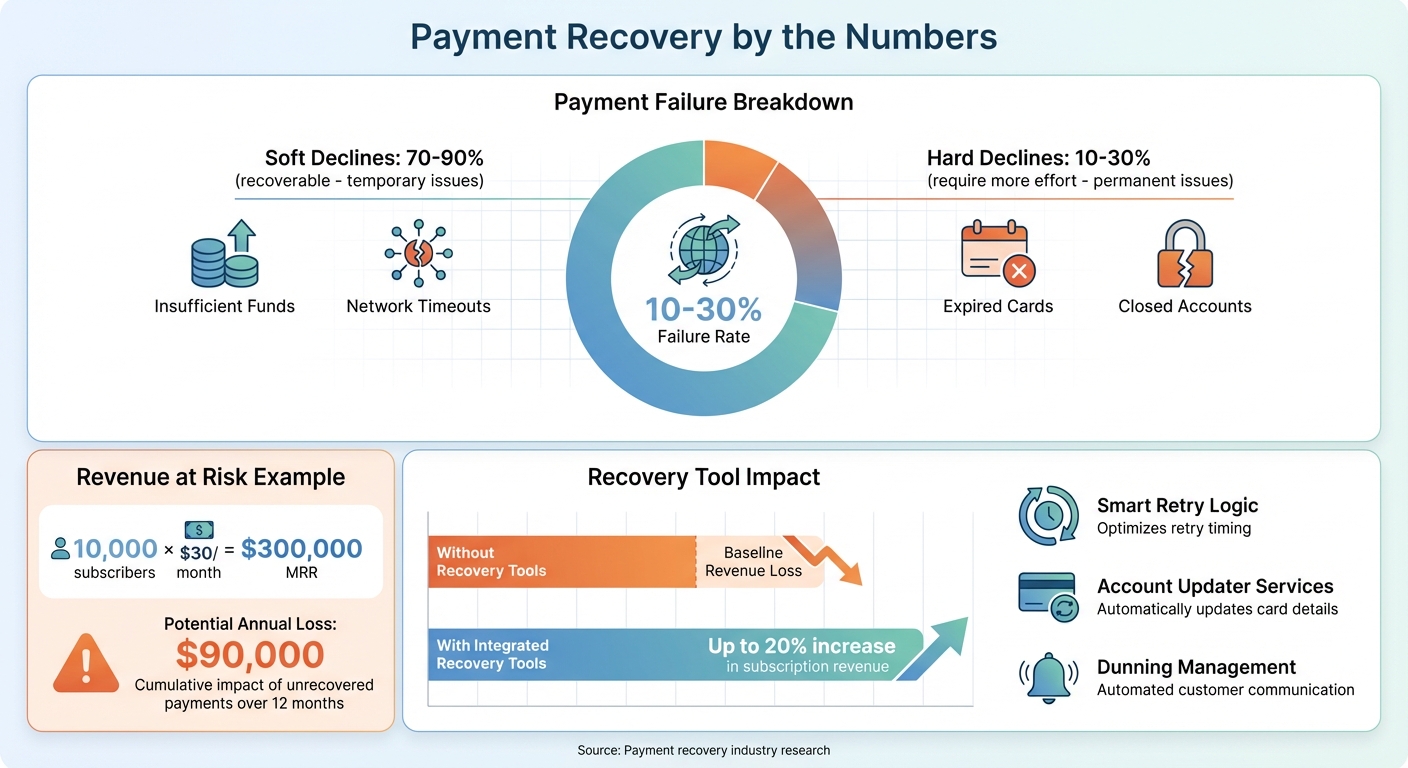
Payment Recovery Statistics: Revenue Impact and Failure Types
Payment Recovery Tools and How They Work
Payment recovery tools are designed to automate the process of recovering failed transactions. These systems handle tasks like retrying charges, updating card details, and notifying customers when their attention is required. Together, they help secure revenue while simplifying the recovery process.
Smart Retry Logic
Smart retry logic takes a strategic approach to handling failed payments by analyzing each transaction to decide the best time and method for retrying. Instead of blindly reattempting charges on a fixed schedule, these systems differentiate between soft declines (temporary issues like insufficient funds or network timeouts) and hard declines (permanent issues such as closed accounts or reported theft). This distinction plays a key role in improving success rates.
For soft declines, retries are spaced out over a 7–14 day period, with timing aligned to peak approval windows. Some advanced platforms take it a step further by using machine learning to predict the optimal retry moments based on issuer behavior. They can even reroute transactions through alternative gateways if the primary processor shows a high rate of declines, further boosting recovery chances.
Account Updater Services
Keeping payment information current is another essential aspect of payment recovery. Account updater services connect directly with card networks like Visa and Mastercard to automatically update expired or reissued card details stored in your billing system. For instance, if a customer’s bank issues a new card due to expiration, loss, or fraud, the updater retrieves the updated card number and expiration date behind the scenes, ensuring your records are refreshed before the next billing cycle.
This proactive approach eliminates the need for disruptive prompts to customers. In the U.S., where millions of cards are reissued annually, account updater services play a vital role in preventing payment failures and reducing involuntary churn. These tools continuously check stored credentials before each scheduled charge, ensuring outdated information is replaced in time.
Dunning Management and Customer Outreach
Dunning management tools step in when retries and account updater services can’t resolve a failed payment – such as when a card is permanently closed, a customer needs to choose a different payment method, or an account remains overdue. These tools automate customer notifications across multiple channels to address the issue.
A typical workflow for U.S. subscription businesses starts with immediate notifications, followed by reminders that gradually increase in urgency while maintaining a respectful tone. Dunning systems allow businesses to customize the frequency and tone of these messages, stopping notifications as soon as the payment is resolved. The goal is to recover the payment without damaging the customer relationship, treating the failure as a routine technical hiccup rather than a personal fault. By doing so, businesses can minimize involuntary churn and build customer trust in the process.
How to Build a Payment Recovery Strategy
A solid payment recovery strategy is essential if you want to reclaim lost revenue effectively. The idea is simple: create a clear process for handling failed payments, starting from the initial decline to either successful recovery or a final write-off. The goal? Address failures quickly, apply the right solutions at the right time, and escalate when necessary. This structured approach not only boosts revenue recovery but also helps maintain strong customer relationships.
Map the Payment Failure Lifecycle
Start by documenting every step of the payment failure process. This includes everything from the initial authorization attempt and decline code to the system’s response and the final outcome. Does the system log the failure? Does it retry immediately or delay action? Follow the entire path, including customer notifications, retry attempts, account status changes (like grace periods or suspensions), and the final resolution – whether that’s a successful charge, a cancellation, or writing off the debt.
Segment your failures to better target your recovery efforts. Break down the data by decline reasons, card networks, customer value (measured in monthly recurring revenue or lifetime value), and product tiers. This segmentation helps pinpoint where revenue is slipping through the cracks and which customer groups need tailored interventions. For instance, high-value customers experiencing repeated soft declines might require personal outreach from an account manager.
Layer Multiple Tools for Better Results
No single tool can solve all payment failures. The most effective strategies combine multiple tools that work together seamlessly. Start with address and card verification to catch issues like invalid details before the charge even happens. Next, use smart retry logic that takes into account factors like issuer behavior, U.S. time zones, and common payday patterns. Account updater services are another must-have – they automatically refresh expired or reissued cards before the next billing cycle, reducing recurring failures without requiring customer action.
When retries and updater services fall short, add a dunning layer. This involves sending reminders through multiple channels – email, SMS, or in-app prompts – to encourage customers to update their payment details. Make it as easy as possible for them by using secure, hosted pages with clear instructions, and time your messages to align with retry attempts. For high-value accounts or repeated failures, escalate the issue to human agents. These agents can reach out by phone, offer flexible payment options, or resolve complex billing problems. Research shows that using an integrated suite of recovery tools can reduce involuntary churn and increase subscription revenue by as much as 20% over the long term.
Of course, while layering tools is effective, it’s equally important to ensure compliance and security throughout the process.
Maintain Compliance and Security
Security and compliance should be the backbone of your recovery strategy. Every step in your workflow must protect customer payment data and meet PCI DSS standards. Never store raw card numbers in your systems. Instead, use tokenization through your payment gateway, ensuring retries, updates, and dunning actions operate on secure, non-sensitive tokens. When customers need to update their payment details, direct them to HTTPS-hosted payment pages, and never request full card numbers via email, SMS, or chat.
For staff handling payment data, implement strict access controls and maintain audited logs. If you’re operating in the U.S., make sure your dunning communications comply with privacy standards. Differentiate between transactional messages, which are necessary for billing, and marketing messages, which must respect unsubscribe preferences. Partnering with a merchant services provider like Secured Payments can simplify compliance. They offer integrated solutions that bundle processing, secure data vaulting, and recovery tools into a single, well-audited platform, making it easier to stay secure and compliant.
sbb-itb-8c45743
How Merchant Services Providers Support Payment Recovery
Merchant services providers play a key role in strengthening payment recovery strategies by offering a fully integrated payment infrastructure. These providers streamline processes like smart retries, alternative routing, and fraud prevention at the transaction level – eliminating the need for complex custom-built solutions. With direct connections to card networks and banks, they provide access to essential tools like account updater and network tokenization. Partnering with a provider like Secured Payments equips businesses with the resources, expertise, and support necessary to recover lost revenue while maintaining compliance and security.
Integrated Payment Solutions
Integrated payment solutions bring together credit card processing, ACH transactions, and other payment methods into a single, unified platform. This consolidation lets businesses manage and monitor recovery workflows for all payment types from one central location. For credit cards, providers incorporate features like smart retry logic, routing, and native integration with account updater tools. When it comes to ACH transactions, they analyze reason codes and bank data to decide whether to retry a failed debit, switch to another payment method, or escalate the issue to customer outreach.
Secured Payments offers a comprehensive platform that handles merchant services, ACH, and e-commerce payment processing. Their solutions ensure smooth and reliable transactions while seamlessly integrating fraud prevention tools and dunning management for better recovery outcomes.
Support for High-Risk Businesses
Businesses in high-risk industries – such as subscription services, digital products, or travel – often deal with unique challenges like higher decline rates, more chargebacks, and increased scrutiny from banks. Merchant services providers specializing in high-risk accounts address these issues with tailored risk models, partnerships with high-tolerance acquiring banks, and advanced pre-transaction screening. These measures help reduce disputes and improve payment success rates.
Additionally, these providers offer chargeback management tools, including automated evidence collection, dispute resolution, and detailed analytics based on reason codes. This approach helps recover revenue that might otherwise be lost. For example, Secured Payments connects high-risk businesses with suitable banking and processing partners, helping them navigate rejections and maintain stable payment processing. They also provide guidance on strategies like descriptor optimization, refund policies, and billing practices to reduce friendly fraud and enhance payment recovery efforts.
Consulting Services for Custom Recovery Plans
Payment challenges vary from business to business, which is why tailored recovery plans are essential. Consulting teams analyze factors like approval rates, decline codes, chargeback ratios, and involuntary churn to identify revenue at risk due to issues like soft declines, expired cards, or ACH returns. Based on these insights, they recommend targeted interventions, such as implementing account updater tools for recurring payments, using smart retries for specific decline codes, or launching segmented dunning campaigns for high-value customers.
Secured Payments provides consulting services to help businesses optimize their payment recovery processes. They assist with analyzing payment data, designing custom workflows, and addressing inefficiencies in revenue recovery. Additionally, they can create dashboards for finance and operations teams to track recovery metrics and test new strategies, ensuring continuous improvement over time.
Conclusion
Payment failures represent a persistent challenge that can quietly drain revenue if left unchecked. Recovery tools play a crucial role in reclaiming failed charges, reducing involuntary churn, and maintaining a steady stream of monthly recurring revenue. By automating processes and addressing issues like soft declines, expired cards, and gateway outages, these tools help businesses transform lost revenue into reliable cash flow and more accurate financial projections.
Key Takeaways
Here’s a quick recap of the most important points:
- Treat every payment failure as a chance to refine your recovery processes – from early detection to retries, updates, customer outreach, and escalation.
- Use automated, intelligent retry systems instead of manual attempts to improve approval rates while keeping costs and customer friction low.
- Leverage account updater services to handle expired or reissued cards seamlessly, especially for Visa and Mastercard subscriptions.
- Run customized dunning campaigns through email, SMS, and in-app notifications, making it easy for customers to resolve payment issues.
- Combine recovery strategies with robust analytics, fraud prevention, and compliance measures (e.g., PCI DSS and data privacy) to ensure security isn’t compromised in the process.
Next Steps for Businesses
To put these strategies into action, consider the following steps:
- Review 3–12 months of data from your payment gateway or billing platform to measure your failed payment rate, pinpoint decline reasons, and set specific recovery goals – such as recovering 10–20% of failed payments within 30 days.
- Use dashboards to monitor progress, focusing on metrics like recovered revenue, avoided churn, and overall impact on monthly recurring revenue.
- Collaborate with a merchant services provider like Secured Payments to optimize your payment infrastructure. This includes fine-tuning gateway routing, implementing smart retries, and setting up tools like card updater services and tailored communication workflows. Their expertise can help you craft scalable strategies that go beyond simply processing payments, ensuring long-term growth and stability.
FAQs
What’s the difference between soft and hard payment declines, and how do recovery tools handle them?
Payment recovery tools play a key role in handling soft declines and hard declines by interpreting the reason codes provided by the card issuer.
Soft declines are usually temporary issues, such as insufficient funds, network glitches, or hitting a card’s limit. These problems can often be fixed by retrying the transaction or contacting the customer to update their payment details.
In contrast, hard declines are permanent and occur due to reasons like invalid account information, closed accounts, or suspected fraudulent activity. Resolving these often requires switching to a different payment method or completing additional verification steps. Recovery tools streamline the process of addressing these declines, helping businesses reduce revenue loss and keep payment systems running smoothly.
How do account updater services help reduce revenue loss?
Account updater services are essential for reducing revenue loss by automatically updating stored payment card details when they expire or change. This process helps businesses avoid declined transactions, ensuring a smooth and uninterrupted payment experience for customers.
By keeping payment information current, businesses can maintain a steady cash flow and minimize disruptions caused by outdated card data. This forward-thinking solution not only ensures customer satisfaction but also supports consistent and reliable revenue over time.
How can businesses maintain security and stay compliant during payment recovery?
To ensure safety and compliance during payment recovery, businesses need to rely on secure payment systems and adhere to industry standards such as PCI DSS. Collaborating with reputable providers that deliver dependable and customized payment solutions is a smart way to protect sensitive data.
Essential steps include implementing encrypted communication to secure transactions, maintaining robust fraud detection protocols, and consistently updating security measures to stay ahead of potential threats. Equally important is offering continuous staff training on compliance and security practices to reduce risks and keep payment processes secure.