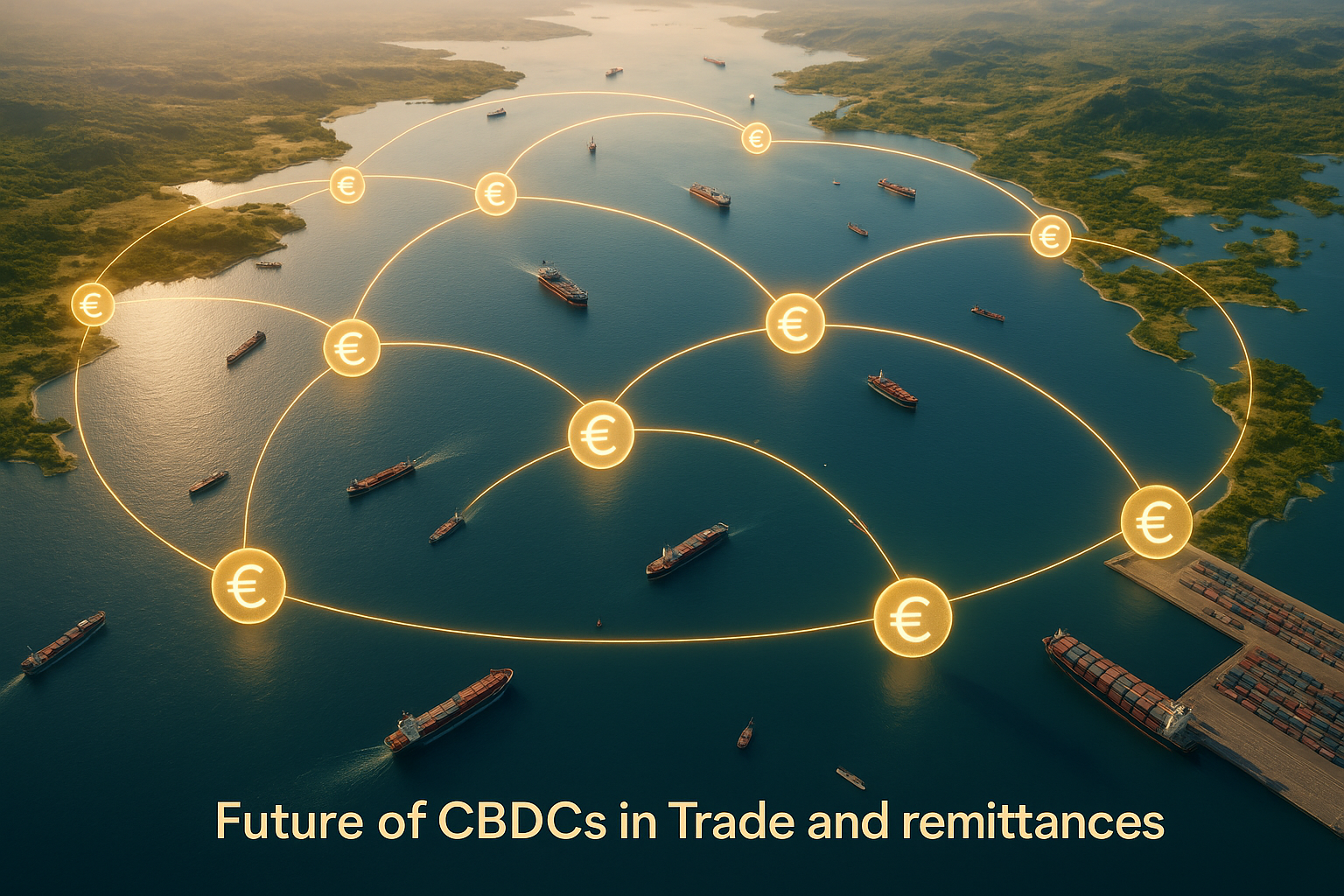
Central Bank Digital Currencies (CBDCs) are reshaping global trade and remittances by offering faster, cheaper, and more transparent transactions. Here’s what you need to know:
-
What are CBDCs?
Digital forms of fiat money issued by central banks. They come in two types:- Retail CBDCs: For everyday use by individuals and businesses.
- Wholesale CBDCs: For financial institutions to handle large-scale transactions.
-
Why They Matter:
Current cross-border payments are slow, costly (average 6.5% remittance fee), and inefficient. CBDCs can reduce settlement times from days to seconds and cut costs by up to 50% by 2027. -
Key Initiatives:
- China’s e-CNY leads retail CBDC adoption.
- Wholesale CBDCs like Project mBridge demonstrated instant multi-currency settlements.
- Swift is testing CBDC integration for global transactions.
-
Benefits for Businesses and Migrants:
- Faster payments for exporters and suppliers.
- Lower remittance fees for migrant workers, ensuring more money reaches families.
-
Challenges:
Privacy concerns, regulatory alignment, and updates to financial systems are critical for widespread adoption.
CBDCs are not just a theory – they’re already being tested globally and could transform how money moves across borders.
How CBDCs Transform Cross-Border Trade
Problems in Current Trade Payment Systems
For U.S. exporters shipping goods to Asia or Europe, cross-border payments often feel like navigating a maze. Transactions have to pass through multiple banks, each adding its own layer of costs and delays. On average, these payments take 2–5 business days to process. On top of that, time zone differences and manual reconciliation issues increase the risk of foreign exchange (FX) losses along the way.
The fees associated with these transactions are another headache. Each intermediary takes a cut, with total costs often reaching several percentage points of the transaction value once processing fees, FX spreads, and compliance charges are tallied up. Compliance checks, including anti-money laundering procedures, are performed repeatedly at different stages, creating delays and false positives. In some cases, banks even "de-risk" by cutting ties with smaller businesses entirely, leaving them without access to international banking services.
CBDC Models for Cross-Border Trade
Central Bank Digital Currencies (CBDCs) aim to tackle these inefficiencies head-on, offering three main frameworks to simplify cross-border trade. These models include:
- Interlinked domestic systems: These preserve each country’s control over its currency while enabling real-time FX settlements.
- Multi-currency platforms: These allow direct, instant exchanges of multiple currencies on a shared ledger.
- Hybrid corridor models: These focus on regional interoperability while maintaining bilateral FX links.
Among these, multi-currency CBDC platforms stand out for their integrated approach. Built on distributed ledger technology, these platforms host multiple wholesale CBDCs in one place. Banks can hold and exchange these currencies directly, bypassing the need for correspondent banks. A leading example is Project mBridge, developed by the BIS Innovation Hub in collaboration with central banks from Hong Kong, China, Thailand, and the UAE. This initiative has already demonstrated the ability to settle multi-currency transactions instantly.
The differences between these models come down to factors like governance (who manages the platform), the depth of technical integration, how FX transactions are handled (centralized order books versus bilateral agreements), and the level of control central banks retain over access, data, and compliance.
Trade Finance and Settlement Applications
CBDCs bring a new level of efficiency to trade finance and settlement. With real-time clearing and settlement, they eliminate the delays caused by batch processing and cut-off times, which currently stretch settlements over several days. Multi-CBDC platforms reduce the number of intermediaries involved, slashing the cumulative fees and FX spreads that inflate transaction costs. In fact, experts estimate that projects like mBridge could save up to $45 billion annually in cross-border payment costs by 2031, primarily through streamlined trade and wholesale flows.
The programmable nature of CBDCs adds even more potential. Smart contracts can automate trade finance processes, such as releasing funds once a shipment is digitally confirmed or customs clearance is completed. Tokenized documents can enable simultaneous transfers of goods and payments, while integrated payment-versus-payment FX settlements minimize risks by locking in exchange rates.
In supply chain finance, CBDCs can improve cash flow for smaller suppliers. For instance, payments can be automatically triggered when delivery milestones are confirmed, ensuring suppliers are paid promptly instead of waiting through long payment terms.
Because these systems operate on secure, auditable ledgers, banks and regulators can monitor transactions in near real time without adding extra manual work. Additionally, real-time FX execution on these platforms provides more transparent and cost-effective pricing, especially for less-liquid currency pairs, compared to the opaque spreads often offered by traditional correspondent banks.
CBDCs in the Remittance Industry
Current Problems in Remittances
For migrants, sending money home often comes with a hefty price tag, long delays, and a lack of transparency. On average, global remittance fees hover around 6–7%, with some payment corridors charging even more. These costs add up because multiple intermediaries – like correspondent banks, money transfer operators, and local agents – each take a slice of the pie. On top of that, settlement times can range from a few hours to several business days, especially when factoring in time zone differences and compliance checks.
Transparency is another major issue. Senders typically don’t know the exact exchange rates, fees, or delivery timelines upfront. Sometimes, funds are held up for additional checks without clear communication, leaving families waiting for money they urgently need for essentials like rent, food, or medical expenses. Many migrants also have to visit physical locations, carry cash, and provide extensive paperwork – a cumbersome process, particularly in countries where remittances make up more than 10% of household income.
The scale of this challenge is enormous. By 2025, global cross-border payments, including remittances, are expected to surpass $200 trillion annually. Digital cross-border remittances alone are projected to grow from $295 billion in 2021 to $428 billion by 2025, with the number of active digital remittance users rising from 57 million to 95 million. Despite this growth, the average cost of remittances remains far above the 3% target set by the G20 and the UN. These inefficiencies highlight the potential for CBDCs to transform how remittances are handled.
How CBDCs Improve Remittances
CBDCs have the potential to simplify and speed up person-to-person remittances, taking cues from the efficiencies already seen in cross-border trade. Retail CBDCs offer a new approach. When countries establish interoperability between their CBDC platforms – whether through shared multi-currency systems or linked domestic networks – transfers can settle almost instantly, providing immediate benefits to migrant families. Instead of relying on a chain of correspondent banks, CBDC transactions are directly recorded and settled on compatible ledgers. This reduces operational costs, foreign exchange spreads, and redundant compliance checks.
This streamlined approach means lower fees for users. CBDCs use programmability to automate currency conversion and compliance checks, enabling near-instant processing – even across time zones. With platforms operating 24/7, including weekends and holidays, families can access funds exactly when they need them most.
Real-world examples show how this works. Project mBridge, a collaboration between the Hong Kong Monetary Authority and central banks from Thailand, the UAE, China, and Saudi Arabia, demonstrated that multi-CBDC platforms can cut out intermediaries, settle payments in real time, and provide richer, standardized payment data.
CBDCs could also help improve financial inclusion. Many initiatives focus on providing low-cost digital wallets that work on basic smartphones – or even offline – to reach underserved and unbanked populations. By lowering transaction costs and enabling quicker, more reliable transfers, families in low- and middle-income countries can receive a larger share of the money sent to them. Additionally, integrating CBDCs with government programs like social benefits or disaster relief could provide a stable, state-backed payment option for those outside traditional banking systems.
Policy and Risk Factors
While CBDCs bring the promise of greater efficiency, they also introduce new challenges. Policymakers must ensure compliance with anti-money laundering (AML) and counter-terrorist financing (CFT) regulations. This may involve using standardized digital identities, risk-based know-your-customer (KYC) measures, and cross-border data-sharing agreements to prevent regulatory loopholes. Foreign exchange rules and capital flow management tools will also need updates to ensure that CBDC transfers don’t bypass existing controls or create new opportunities for fraud.
Privacy and data protection are critical concerns. CBDC systems naturally generate detailed, real-time transaction data, raising fears that this information could be misused for surveillance or discriminatory profiling if not properly safeguarded. To address these risks, central banks are designing systems that separate transaction data from identity information. In this setup, intermediaries handle KYC processes, while central authorities only see aggregated data. Tiered digital wallets, offering lighter KYC for low-value transactions and stricter requirements for larger transfers, could strike a balance between privacy, inclusion, and security.
The adoption of CBDC-based remittances could also disrupt traditional service providers and correspondent banks, potentially cutting into their fee income and exchange rate margins, especially in high-cost corridors. However, many of these firms might adapt by becoming front-end service providers on CBDC platforms. They could focus on offering user-friendly apps, robust compliance services, and extra features like bill payment and budgeting tools, while outsourcing the settlement process to CBDC infrastructures. Fintech companies already operating in the digital remittance space are well-positioned to integrate with CBDC systems, improving settlement speed and reducing costs without losing their customer-first approach.
Lastly, legal frameworks must evolve to address issues like the legal tender status of foreign CBDCs, jurisdictional conflicts in cross-border transactions, and liability for technical or operational failures on shared platforms. International organizations such as the IMF, BIS, and G20 are working with central banks to develop common standards for cross-border CBDC use. Strong data protection rules, clear limits on data retention and sharing, and robust cybersecurity measures will be essential to earning public trust in CBDC-based remittance systems.
What CBDCs Mean for U.S. Businesses and Payment Providers
Opportunities for U.S. Payment Providers
Central Bank Digital Currencies (CBDCs) are opening up new possibilities for U.S. payment providers, especially in streamlining cross-border transactions. With global cross-border payments exceeding $150 trillion annually, integrating multi-currency CBDC corridors could offer a faster, more efficient alternative to traditional systems like SWIFT. Successful pilots, such as Project mBridge and upcoming SWIFT trials, demonstrate how settlement times can shrink from days to mere seconds.
The momentum behind wholesale CBDCs is undeniable. A staggering 91% of 93 central banks are actively exploring retail or wholesale CBDC models. For payment processors, this shift presents a chance to tackle long-standing challenges in remittances, such as delays of 4–5 days and fees that average 6.3%. By adopting CBDC rails, businesses can tap into a rapidly growing market, with global CBDC payments projected to surge from 307.1 million to 7.8 billion transactions by 2031. This growth could save businesses up to $45 billion annually in cross-border payment costs.
To seize these opportunities, merchants must also modernize their systems to stay ahead.
What Merchants Need to Do
For U.S. merchants, adapting to CBDCs means upgrading their payment infrastructure to handle these new digital currencies effectively. Here’s what that involves:
- Integrating CBDC-compatible gateways: Real-time, multi-currency settlements powered by distributed ledger technology are becoming essential. Initiatives like the Digital Dollar Project, which partnered with Western Union to test remittance corridors between the U.S. and the Philippines, provide valuable insights into how this integration can work.
- Streamlining reconciliation processes: CBDC transactions settle instantly, unlike traditional batch processing that takes days. Merchants will need to update their accounting and treasury systems to manage real-time settlements efficiently.
- Strengthening compliance measures: Adapting to CBDCs also requires robust compliance frameworks, including transaction limits and Know Your Customer (KYC) and Anti-Money Laundering (AML) protocols. Keeping an eye on ongoing G20 pilots and BIS projects will help merchants stay aligned with evolving global standards.
As these changes unfold, trusted payment providers are already stepping in to help businesses navigate this transition.
How Secured Payments Supports the Transition

Secured Payments is leveraging its expertise to guide U.S. merchants through the shift to CBDCs. The company offers tailored consulting and integrated solutions designed to address key areas like platform selection, payment strategy optimization, and cost management.
As multi-CBDC arrangements move from pilot programs to full-scale implementation, Secured Payments’ robust solutions – including ACH transaction capabilities – provide a solid foundation for incorporating CBDC rails. With a focus on reliability and 24/7 customer support, they help merchants handle the complexities of real-time gross settlement and cross-border digital currency transactions with confidence.
sbb-itb-8c45743
Future Outlook and Possible Scenarios
Expected Adoption Timelines
As the CBDC (Central Bank Digital Currency) landscape continues to evolve, the pace of adoption is picking up. Many major economies are now moving past the initial pilot stages. While only a handful of countries have fully launched their CBDCs, 69 nations are currently in advanced development or pilot phases.
Wholesale CBDCs, which focus on interbank settlements and trade finance, are projected to enter production-like use in the latter half of the 2020s. Key trade routes, such as those between Asia and the Middle East and within Asia itself, are expected to lead the way in adopting CBDC-based settlement systems. For instance, Russia’s largest banks have committed to enabling digital ruble transactions for their clients by September 2026.
On the other hand, retail CBDCs aimed at consumer remittances are likely to take longer to roll out. Concerns around privacy and the impact on the banking sector are contributing to these delays, meaning that retail remittance use cases will likely trail wholesale trade settlement applications by several years. For U.S. businesses, this means prioritizing CBDC integration for large-scale trade operations over consumer-focused remittance products in the near term.
Possible Outcomes for Global Trade and Remittances
Looking ahead, three potential scenarios could define how CBDCs reshape global payments over the next decade:
- Interoperable multi-CBDC systems: Central banks worldwide could adopt CBDCs that work seamlessly together, using shared technical standards like ISO 20022. This would streamline cross-border settlements, reduce foreign exchange complexities, and include built-in compliance checks.
- Fragmented regional ecosystems: Some regions, such as Asia, Europe, and emerging-market coalitions, may develop their own CBDC networks. While this could improve efficiency within specific regions, limited compatibility across regions might necessitate specialized intermediaries for cross-border transactions.
- Digital dollar dominance: The U.S. could maintain its leadership in global payments by enhancing existing dollar-based systems rather than pursuing a retail CBDC. Following an executive action in 2025 halting retail CBDC development, the U.S. has focused on upgrading current dollar payment infrastructures, expanding the use of regulated stablecoins, and supporting tokenized bank deposits.
Key Developments to Monitor
Several initiatives are worth keeping an eye on for insights into CBDC adoption and interoperability. For instance, Project mBridge, spearheaded by the BIS Innovation Hub in collaboration with multiple central banks, is working to enable instant, low-cost multi-currency settlements for trade. Similarly, Swift’s live trials planned for 2025 aim to explore how CBDCs and tokenized assets can integrate with existing messaging systems, which could accelerate adoption across banks in North America, Europe, and Asia.
U.S. businesses, in particular, should stay updated on announcements from organizations like the BIS, IMF, and Swift. These updates will be critical in understanding the technical and compliance requirements for incorporating CBDC payments into current systems. Companies like Secured Payments are already preparing merchants to handle multiple digital currencies alongside existing payment methods. These milestones will be key in guiding U.S. payment providers as they adapt to emerging global standards.
Conclusion
Central Bank Digital Currencies (CBDCs) are set to transform the way international payments work. With the cross-border payments market exceeding a staggering $200 trillion annually, the potential impact is huge. Benefits include faster transaction times, reduced costs – especially with the G20 targeting a reduction in remittance fees from the current 6.5% average to half that by 2027 – and greater transparency in areas like trade finance and consumer remittances.
For U.S. businesses involved in global trade and remittances, the time to prepare is now. The development of wholesale CBDCs for interbank settlements and multi-currency platforms, such as Project mBridge, signals that payment systems are evolving quickly. Companies that adopt API-driven, multi-rail payment systems will be better equipped to integrate CBDCs as they become available. This shift requires businesses to embrace innovation and build strong partnerships to stay competitive.
Payment providers will play a critical role in this transition. As CBDCs begin to coexist with traditional payment methods like credit cards, ACH, and wire transfers, businesses need partners who can handle multiple transaction systems at once. Providers like Secured Payments, for example, offer tools such as credit card processing, e-commerce solutions, high-risk merchant account services, and consulting. These capabilities can help businesses navigate the growing complexity of digital and traditional payment systems.
To stay ahead, businesses should focus on strengthening compliance programs, identifying trade corridors that would benefit most from CBDC-based payments, and working with experienced processors to adapt to the changing payment landscape. While wholesale CBDC applications for trade settlements are advancing faster than retail remittance solutions, significant progress is expected before 2027.
As central banks move from pilot programs to full-scale CBDC rollouts, the global payment landscape is changing rapidly. Businesses that prioritize readiness now will gain an edge in speed, cost efficiency, and market access in the years to come.
FAQs
How can CBDCs make cross-border transactions faster and more affordable?
Central Bank Digital Currencies (CBDCs) make cross-border transactions much easier by allowing direct digital transfers between central banks. This eliminates the need for intermediaries and reduces dependence on traditional banking networks, which often come with higher costs and slower processes.
With CBDCs, international payments can be settled almost instantly, unlike the delays that are common with conventional systems. This faster approach not only saves time but also cuts costs, making global trade and remittances more efficient and dependable for both businesses and individuals.
What are the biggest challenges to adopting CBDCs worldwide?
The worldwide rollout of Central Bank Digital Currencies (CBDCs) comes with its fair share of challenges. A significant issue is achieving interoperability between various national systems, which is essential for smooth cross-border transactions. Without this, the global flow of digital currencies could face serious bottlenecks.
Another pressing concern is balancing user privacy with the need to prevent illegal activities like fraud and money laundering. Striking this balance is no small feat, as it involves navigating complex regulatory and technological landscapes.
On top of that, cybersecurity threats pose a constant risk. Safeguarding CBDCs from potential attacks is crucial to maintaining trust and stability. Speaking of stability, it’s also vital to ensure that these digital currencies don’t unintentionally disrupt the existing financial systems.
Lastly, gaining widespread acceptance among businesses and consumers will hinge on building trust and proving that CBDCs offer clear, tangible advantages over the payment systems people already rely on. Without this trust, adoption could be an uphill battle.
How can CBDCs help underserved communities access financial services?
Central Bank Digital Currencies (CBDCs) could change the game for underserved communities by providing secure and straightforward digital payment solutions. Unlike traditional banking systems, which often come with high fees and limited branch availability, CBDCs can break down these barriers, making financial services more accessible to everyone.
Thanks to the prevalence of mobile devices, CBDCs offer a way for people to send, receive, and manage money digitally, even in regions lacking robust banking infrastructure. This opens the door for greater economic participation and could help enhance financial stability for individuals who have historically been left out of the system.